A precise landing architecture
A mission like this would need repeatable heavy-cargo landing on Mars, surface navigation, hazard avoidance, and the ability to place equipment close enough to heritage sites without damaging them.

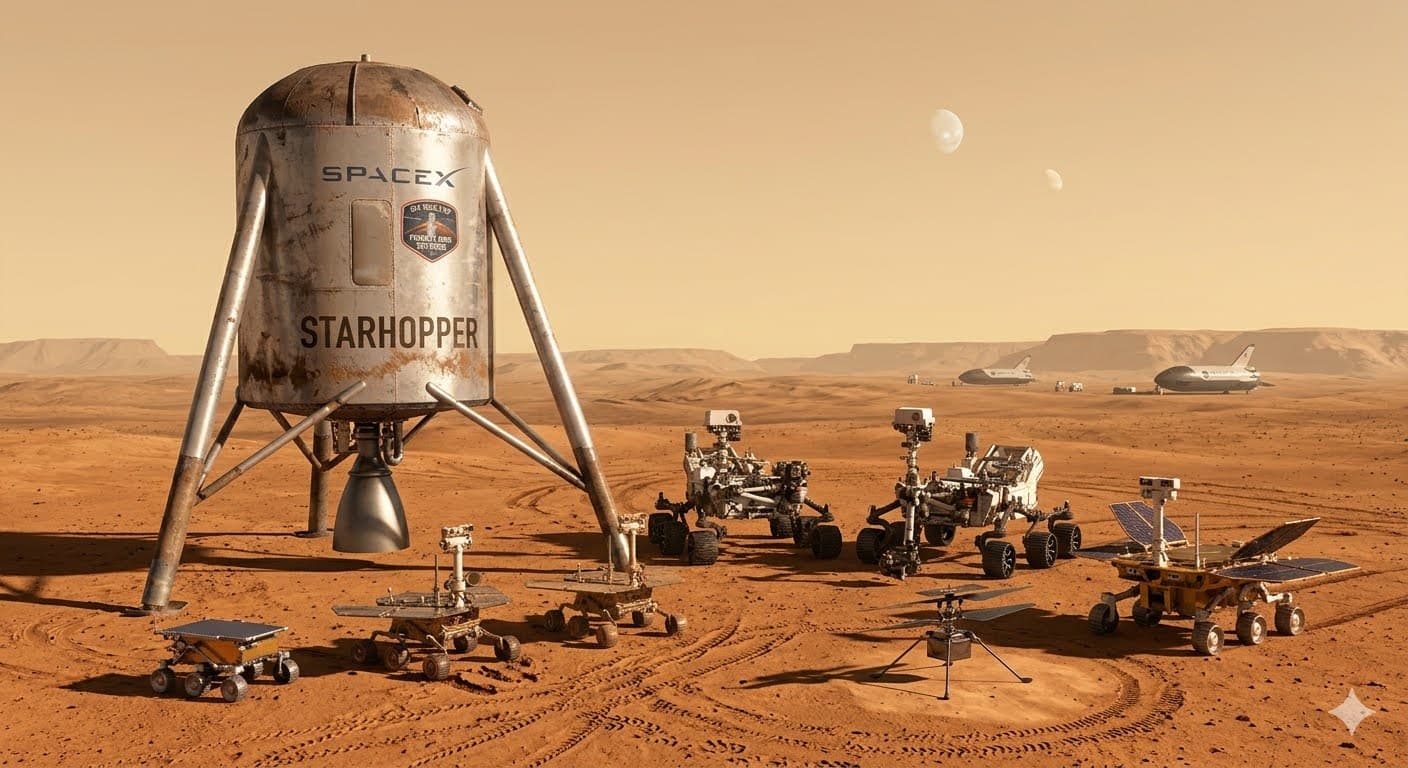
The image is not a current mission plan. It is a vision: Starhopper standing like a weathered monument beside the rover family, with the machines of exploration gathered as if Mars itself has become a museum of human perseverance.
To make something like this real, humanity would first have to learn how to land heavy equipment safely, protect historic spacecraft, operate across long distances, and build systems that can survive years of cold, dust, radiation, delay, and uncertainty.
The significance is not that metal reached Mars. The significance is that love did: love of knowledge, love of future generations, love of the fragile light we carry together.
A unifying Mars mission would be less like a photo opportunity and more like building a durable civilization-grade logistics chain on another planet.
A mission like this would need repeatable heavy-cargo landing on Mars, surface navigation, hazard avoidance, and the ability to place equipment close enough to heritage sites without damaging them.
The rovers are spread across different Martian regions. Unifying their story would require autonomous haulers, scout drones, mapping networks, and patient traverse planning across hostile terrain.
Mars dust, cold nights, and distance from Earth punish fragile systems. The mission would need durable solar, nuclear, battery, and thermal systems designed to operate for years.
Every command would cross minutes of signal delay. The crew, robots, and orbiters would need resilient relay networks and enough autonomy to keep working when Earth is only listening.
The old rovers are not junk. They are human artifacts. Visiting, preserving, or relocating them would require strict contamination control and a deep respect for what they represent.
The mission would only be worth doing if it served science, memory, cooperation, and future life. The machines matter because of the human promises they carried.