Send the tankers first
Autonomous propellant ships would leave years in advance, each carrying fuel, power systems, guidance, communications, and enough self-repair capability to survive alone.

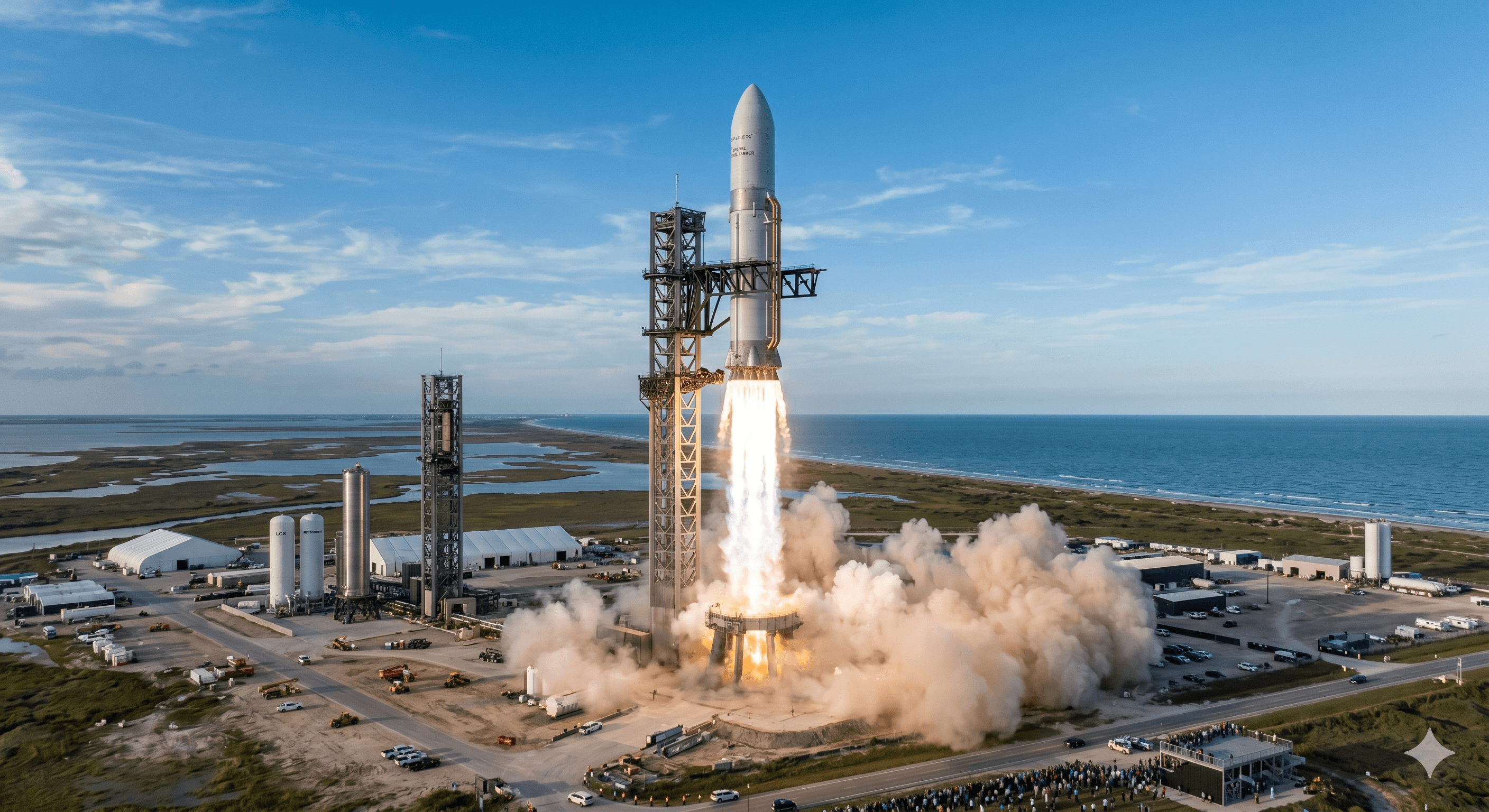
This page imagines a single-stage-to-orbit craft shaped more like a flying wing than a traditional deep-space stack, traveling not by one giant throw, but by a patient chain of autonomous fuel depots sent ahead like stepping stones on a pond.
In this concept, the graceful winged vehicle is the part people remember, but the real breakthrough is logistical humility. Drone tankers leave first, spreading out across the long path to Jupiter space. Each one waits like a prepared branch, allowing the main craft to hop, refuel, recalibrate, and move again.
The metaphor is a bird crossing water by touching a series of safe stones. The engineering version is less poetic and far harder: every stone has to arrive first, remain alive for years, and be trustworthy when a crew finally depends on it.
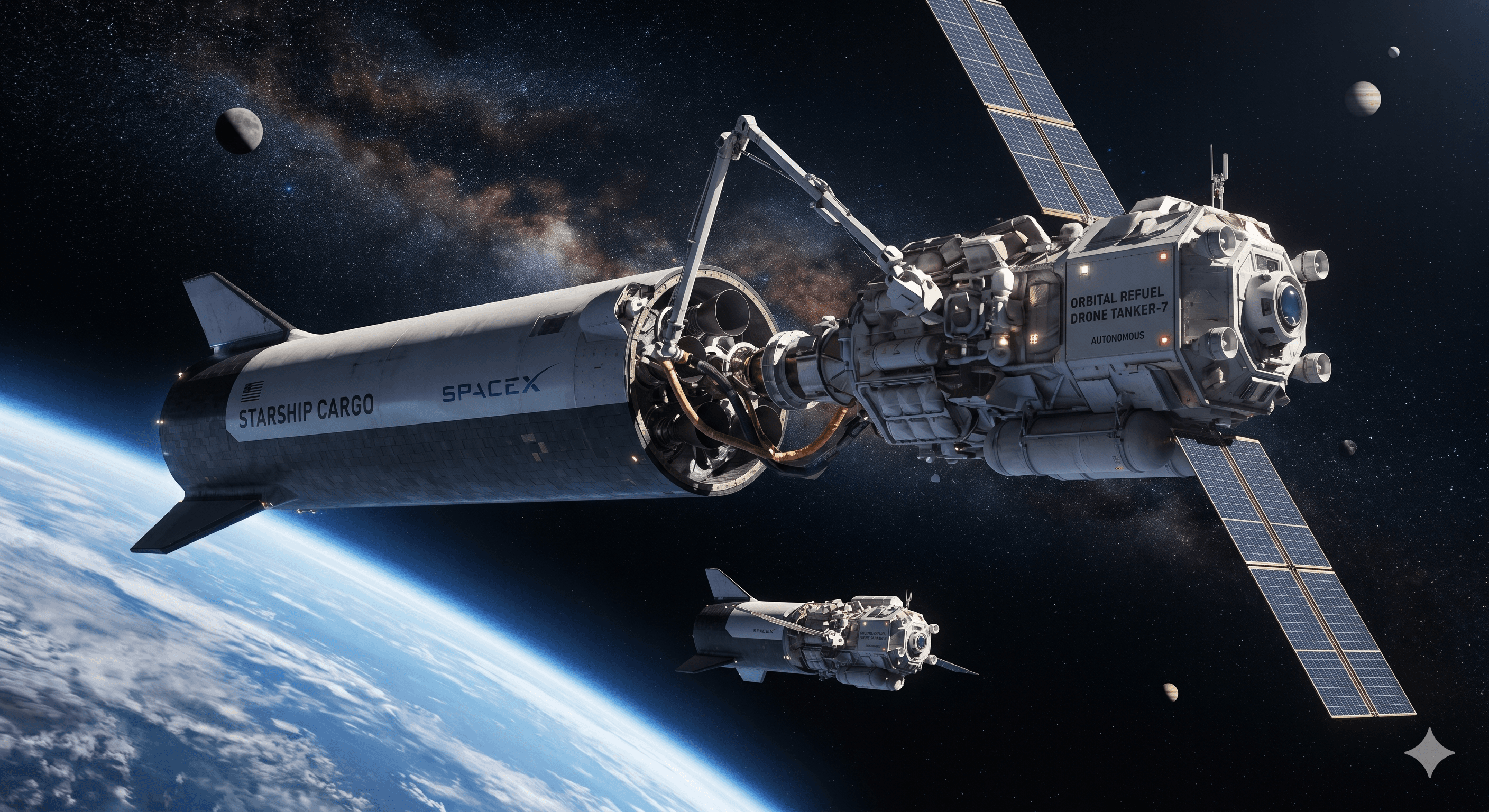
Your artwork gives the idea a clearer emotional shape: a dark, gliding vehicle moving between pre-positioned tankers while Europa and Jupiter dominate the horizon. It helps make the architecture feel less like abstract logistics and more like a choreographed expedition.
The image and clip work best as a mission moodboard. They show what the route is trying to accomplish: not one impossible burn, but a chain of prepared rendezvous that lets the craft keep hopping forward into deeper space.
The glamorous craft is the last piece to leave. Everything before that is a campaign of freight, timing, fuel management, navigation, and quiet reliability.
Autonomous propellant ships would leave years in advance, each carrying fuel, power systems, guidance, communications, and enough self-repair capability to survive alone.
Instead of demanding one impossible all-at-once vehicle, the mission would create a chain of usable waypoints. Each depot becomes a temporary island of energy, fuel, and information.
The crewed or high-value exploration craft would depart only after the route is proven. Its job would not be to carry the whole journey inside itself, but to move elegantly from one prepared node to the next.
At every stop the vehicle would replenish propellant, inspect thermal shielding, validate navigation, upload software improvements, and wait for the next safe departure window.
By the time the craft reaches the Jovian system, it would need to transition from long-range cruise behavior into radiation-hardened operations near one of the most hostile environments in the Solar System.
To send a Starship-scale vehicle all the way to Europa using a continuous trail of autonomous tankers, you are not building a line of parked gas stations. You are launching a timed wave of robotic depots that each have to arrive at the exact place and speed needed for a future rendezvous. Every step outward gets punished by the exponential cost of carrying propellant for propellant.
Roughly 1,200 metric tons of methane and liquid oxygen.
On the order of about 6.5 to 9 km/s depending on trajectory and how aggressively you want to travel.
Each tanker placed farther out in space needs a sub-fleet behind it just to push it there with useful fuel still left onboard.
These are hypothetical order-of-magnitude estimates for what a stepping-stone architecture might demand if the goal were a fast, high-energy human transit instead of a slower gravity-assist route.
| Stepping stone | Purpose | Support launches from Earth |
|---|---|---|
| Low Earth Orbit | Fully refuel the main ship before departure from Earth. | ~5 to 8 |
| High Earth / Cis-Lunar Space | Top off the ship as it pushes beyond Earth gravity and tries to maximize outbound speed. | ~15 to 20 |
| Deep Space Midcourse | Intercept the ship between Earth and Jupiter so it still has meaningful braking and maneuvering fuel left. | ~80 to 100+ |
| Jupiter / Europa Capture | Provide the propellant needed to slow down enough to enter the Jovian system and begin Europa operations. | ~200+ |
Add those legs together and the campaign lands in the rough range of 300 to 400 total Starship tanker launches from Earth for one fast Europa mission. Most of those ships never see Europa. They are spent building the road for the next ship farther out.
A Europa hopper mission is compelling because it replaces brute force with choreography. But choreography is fragile. It depends on stable propellant, durable robotics, autonomous rendezvous, and a mission architecture that can absorb failure without losing the whole story.
Europa matters because it may contain a deep subsurface ocean in contact with rock, energy, and chemistry that scientists care about when they ask whether life could emerge beyond Earth. Reaching it is not just about distance. It is about whether humanity is willing to build the patient systems needed to approach a profound question responsibly.
If Mars invites us to think about settlement, Europa invites us to think about reverence. It reminds us that exploration can be a form of listening.
Pure ship count is not the craziest part. As of mid-2026, Boeing has built more than 12,000 737 aircraft. Against that backdrop, a 300 to 400-vehicle tanker family sounds less impossible as a manufacturing challenge and more impossible as a mission-timing, launch-rate, orbital-precision, and propellant-economics challenge.
In other words: humanity can manufacture in volume. The harder part is building hundreds of space vehicles that must survive launch, cryogenic storage, autonomous navigation, and deep-space rendezvous with almost no room for schedule slip.
The romantic picture is a neat chain of tankers waiting in the dark. The operational picture is messier: months of staggered launches, multiple parking orbits, tanker-to-tanker support, deep space intercept planning, and a whole campaign designed so the actual crewed ship is only launched after the route is already proven.
That is why gravity assists are so tempting. Orbital mechanics can do the heavy lifting for free if you are willing to wait.
People cannot coast forever. Food, water, oxygen, radiation, muscle loss, psychology, and zero-G exposure all turn duration into one of the mission's biggest design constraints.
Travel time: 13 to 14 months
Realistic for humans? Yes, but astronomically expensive.
A 300 to 400-launch tanker campaign could keep the ship moving on a fast direct route, but the price is an entire industrial armada launched years in advance.
Travel time: 2 to 2.5 years
Realistic for humans? The future-tech middle ground.
A more conventional direct mission without a full tanker highway would likely still be extremely hard, but it avoids the wild multiplication of support launches.
Travel time: 3 to 5 years
Realistic for humans? Great for cargo, terrible for humans.
Venus-Earth-Earth or similar slingshot routes let orbital mechanics do the work for free, but they stretch human transit into a multi-year survival problem.
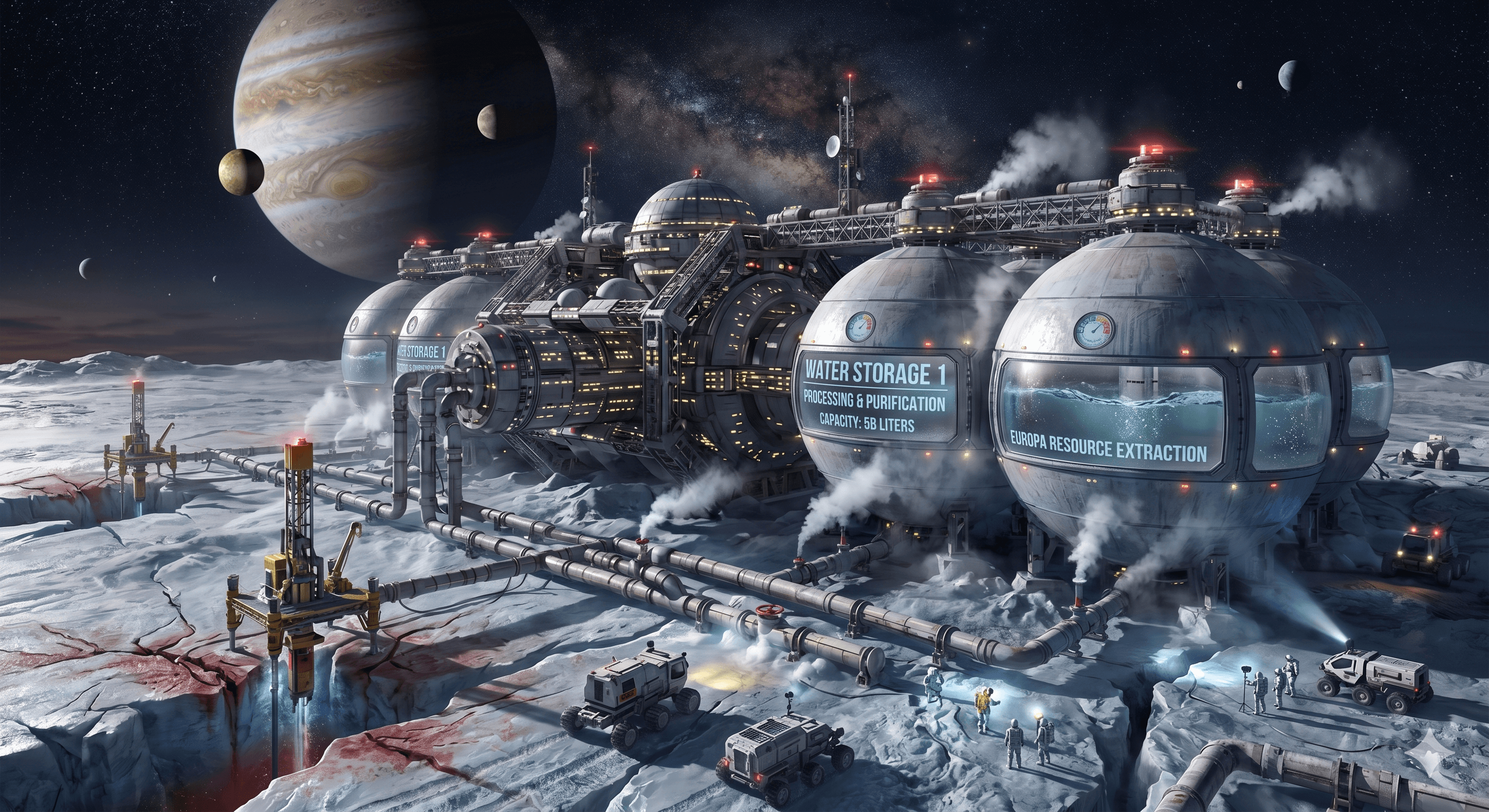
If you stack science fiction, brute-force engineering, and real orbital mechanics side by side, Europa becomes a lesson in how expensive distance really is.
| Propulsion / method | Travel time to Europa | Realistic for humans? |
|---|---|---|
| Speed of Light | ~33 to 53 minutes | Physics says no. |
| The Expanse style 1G transit | ~5 to 9 days | Science fiction. |
| Brute Force Starship Armada | ~13 months | Yes, but with an immense launch campaign. |
| Standard Starship direct mission | ~2 to 2.5 years | Possibly the future sweet spot. |
| Gravity assist trajectory | ~3 to 5 years | Excellent for cargo, punishing for crews. |
Whether or not this exact mission ever flies, it points toward a deeper engineering philosophy: future exploration will depend on infrastructure, trust, and the willingness to build routes before we build legends.
Can single-stage-to-orbit vehicles ever become efficient enough to justify this kind of architecture?
How much autonomy is acceptable when a missed docking could strand the whole mission?
Could tanker depots double as communication relays, sensor nodes, and repair stations?
What combination of nuclear power, solar power, and storage would keep depots alive for years?
How do we design a mission that is visually bold without lying about the extraordinary engineering burden?
Christopher Columbus's first Atlantic crossing took about 70 days. Mars sits around 6 months away on a typical human-class mission. A fast brute-force Europa mission in this concept lands around 13 months. That rhythm is strange enough to feel poetic.
About 3 months in the age of sail.
About 6 months on a typical crew-class transfer.
About 13 months in the fast armada concept.
Isn't that ironic. After Mars, Europa is almost double the transit time.
Atlantic Ocean: about 3 months. Mars: about 6 months. Europa: about 13 months.
I do not believe in coincidences. I see a pattern: Jupiter and Europa start to look less like a destination and more like a future gas station with fuel and water waiting to be understood.