Billions spent, nothing launched
The X-33 cost $1.28B before cancellation. NERVA consumed $1.4B over 18 years. The X-38 absorbed over $500M and was 90 percent complete. These were serious industrial programs, not concept studies.


Some of the most extraordinary engineering in NASA's history never left the ground. Budget cuts, treaty obligations, composite tank failures, and shifting mission priorities ended programs that had already consumed billions of dollars, decades of research, and sometimes 90 percent of their development work. This is their story.
These are not failed ideas. Most were technically sound. The obstacles that stopped them had nothing to do with the quality of the engineering. Politics, cost, treaty obligations, and sometimes a single composite tank made the difference. Understanding what was abandoned, and why, is essential context for evaluating what is being built today.
The X-33 cost $1.28B before cancellation. NERVA consumed $1.4B over 18 years. The X-38 absorbed over $500M and was 90 percent complete. These were serious industrial programs, not concept studies.
DC-X's vertical landing directly inspired SpaceX. The HL-20 became Dream Chaser. NERVA's physics data drives modern nuclear thermal propulsion research. Cancellation ended the programs, not the concepts.
Starship, Artemis, nuclear thermal engines for Mars: all of these have predecessors in this archive. The engineering problems that stopped prior programs are the same ones being solved now, with better materials, manufacturing, and computers.
Before NASA settled on the Saturn V and the lunar orbit rendezvous approach, engineers were drawing rockets of almost incomprehensible scale. These were designed to hurl entire spacecraft toward the Moon in a single shot.

The largest rocket ever seriously designed. Sea Dragon would have been assembled in a shipyard, floated out to sea, and launched vertically from the ocean surface. Its single first-stage engine produced 355.8 meganewtons of thrust, roughly six times what Saturn V put out.
NASA's selection of lunar orbit rendezvous for Apollo cut the required payload mass in half, eliminating the need for a rocket this large. Saturn V was sufficient.
Sea Dragon set the outer limit of what chemical propulsion could theoretically achieve. Its ocean-launch concept resurfaces in modern heavy-lift proposals.

The Nova family was NASA's baseline super-heavy for direct ascent. The idea was to fly a single spacecraft from Earth to the Moon's surface without any orbital rendezvous. Nova 8L, the largest variant, would have stacked eight F-1 engines on the first stage.
John Houbolt's lunar orbit rendezvous mode, adopted in 1962, halved the required payload mass. Saturn V could do the job. Nova was never needed.
The F-1 engine development program, driven partly by Nova requirements, produced the most powerful single-chamber rocket engine ever flown. It powered every Saturn V.
Chemical rockets are fundamentally limited by their exhaust velocity. Nuclear propulsion promised to break that ceiling, offering specific impulse values two to fifteen times better than anything burning hydrogen and oxygen. Three distinct approaches reached serious development.

Nuclear Engine for Rocket Vehicle Application. The idea is simple: heat liquid hydrogen with a nuclear reactor instead of combustion and exhaust it through a nozzle. The result is twice the efficiency of the best chemical engine, making Mars missions practical.
President Nixon canceled all human Mars mission planning in 1973 due to Vietnam War costs and budget pressures. Without a Mars mission to justify NERVA, Congress ended the program.
The thermal and neutron physics data from Project Rover still guides modern NTP research. NASA's current DRACO program and the proposed Mars transit vehicles are direct descendants.
Physicist Ted Taylor and Freeman Dyson proposed the most audacious propulsion concept ever seriously funded: detonate nuclear bombs behind a massive pusher plate, absorb the blast with shock absorbers, and ride the pulse to orbit and beyond.
The 1963 Partial Test Ban Treaty prohibited nuclear detonations in the atmosphere, underwater, and in space. Orion was illegal before it could be built.
Freeman Dyson's analysis of Orion shaped decades of thinking about interstellar propulsion. The physics are sound. Only politics and treaty law prevent it.

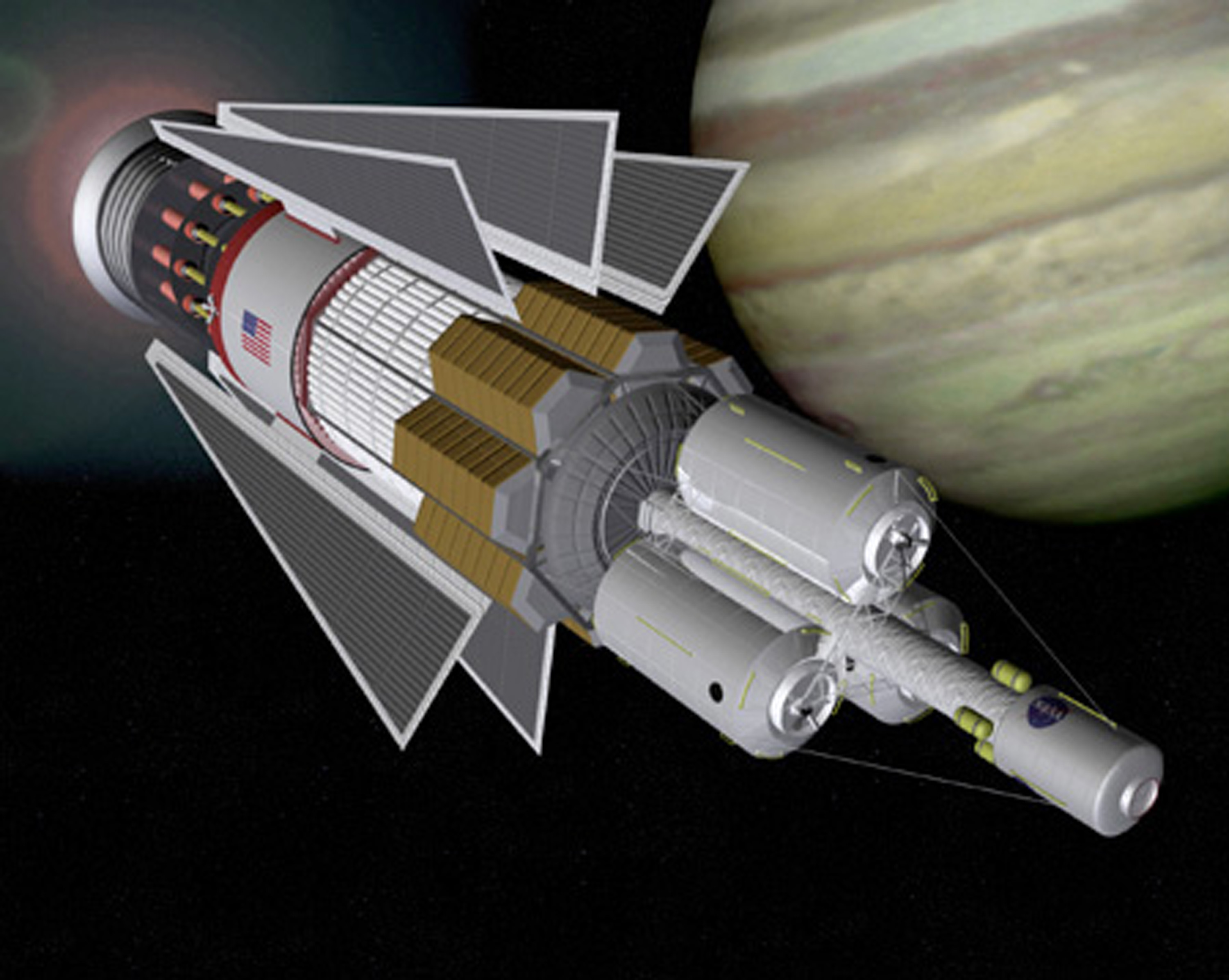
Jupiter Icy Moons Orbiter would have been the most capable robotic spacecraft ever designed: a 36,000-kilogram ship powered by a 200-kilowatt fission reactor driving ion and Hall thrusters, capable of orbiting Europa, Ganymede, and Callisto in sequence.
Estimated costs exceeded $16 billion. A new NASA administrator deprioritized it in 2005 as too ambitious. The technology had not been proven and the mission scope kept growing.
Solar electric propulsion work from Prometheus fed Dawn, Hayabusa2, and Psyche. Europa Clipper, launched in 2024, is its direct spiritual successor, though it runs on solar power instead.
The holy grail of launch vehicle design: a single vehicle that takes off, reaches orbit, and returns with no expendable stages. If it could be done reliably and quickly, it would reduce launch costs by an order of magnitude. Three serious attempts were made. Each failed for a different reason.

The National Aero-Space Plane would have been an air-breathing scramjet spaceplane: take off from a runway, accelerate to Mach 25 on atmospheric oxygen alone, then burn LOX/LH₂ to reach orbit. A flight from Washington D.C. to Tokyo would take two hours.
Scramjet engines proved far heavier than predicted. The structural mass fraction made reaching orbit thermodynamically impossible with available materials. The entire premise was wrong.
NASP-era scramjet research produced the X-43A, which reached Mach 9.6 in 2004. That is still the air-breathing speed record. Hypersonic vehicle design descends directly from this work.

An 85-percent-complete reusable SSTO lifting body when NASA canceled it. The wedge-shaped vehicle used two linear aerospike engines. These nozzles used the vehicle's body as one wall, adapting automatically to all altitudes. The whole thing was designed to fly like an airplane, not come down as a capsule.
A composite liquid hydrogen tank catastrophically delaminated during cryo-loading in November 1999. Repairing it with metallic tanks added too much mass to reach orbit. The mission-critical innovation had failed.
The XRS-2200 aerospike engine test data remains foundational to nozzle design. The X-33 program proved composite cryogenic tanks require extreme care, a lesson SpaceX Starship relearned the hard way with carbon fiber.

A 12-meter autonomous cone that took off vertically, hovered, translated sideways, and landed on its tail. On August 18, 1993, it became the first rocket in history to execute a controlled vertical landing. Its ground crew turned it around for the next flight in 26 hours.
Congressional funding was cut before a full-scale version could be built. The program was transferred to NASA, which repainted it and called it DC-XA before losing it to a hard landing.
DC-X is the direct proof-of-concept ancestor of SpaceX Falcon 9 booster recovery and Blue Origin New Shepard. Elon Musk has cited it explicitly as foundational to SpaceX's VTVL approach.
Once the ISS was committed to, NASA needed a dedicated lifeboat: a spacecraft capable of returning all seven crew members to Earth autonomously if an emergency struck. Two serious designs were built, both canceled within two years of each other.

A sleek lifting body derived from the Soviet BOR-4 reentry vehicle, designed to carry ten people from orbit to a runway landing. It had no main engines at all, just a pure glider, and it could be launched atop a Titan IV. Students at NC State and NC A&T built a full-scale wooden mockup.
NASA chose Soyuz as the ISS crew return vehicle. The HL-20 had no path to a funded flight program once that decision was made.
The entire HL-20 aerodynamic database was transferred to Sierra Nevada Corporation. Dream Chaser, which is scheduled to fly ISS cargo missions, is its direct descendant.

A seven-person lifting body based on the X-24A research aircraft, designed to detach from the ISS and land autonomously under a 687-square-meter parafoil. That is the largest parafoil ever built. Vehicle 201 was 90 percent complete and had passed nearly all drop tests from a NASA B-52.
In 2002, NASA administrator Sean O'Keefe's 'Core Complete' ISS policy eliminated any non-essential ISS development. The X-38 was deemed discretionary. Over $500M had already been spent.
Parafoil precision-landing research from X-38 fed SpaceX Cargo Dragon's recovery work and military precision-airdrop programs. Boeing CST-100 and Orion inherit its crew-return philosophy.

These sources ground the vehicle descriptions, specifications, and cancellation histories in official records, NASA technical reports, and aerospace history archives.