Design & Identity

NASA Employees

Hypothetical Design Study

What if NASA redesigned their logo
every decade?

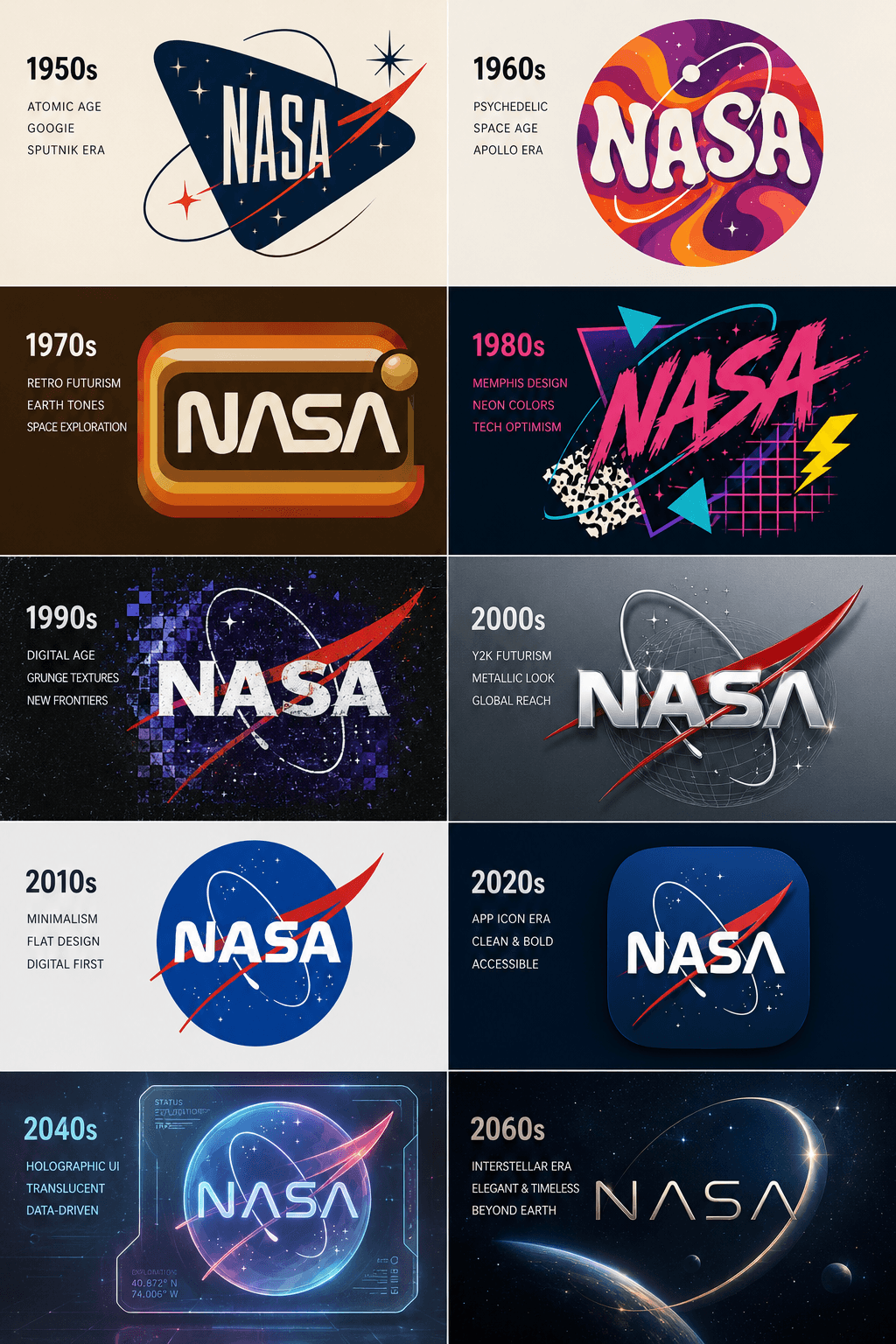
A visual thought experiment: ten eras of design culture, each re-interpreted through the iconic NASA wordmark — from the Atomic Age optimism of the 1950s to the quiet interstellar elegance of the 2060s.

The Full Infographic

Ten Decades. One Icon. Infinite Interpretations.

Each era's design language leaves a distinct fingerprint on the NASA wordmark — a testament to how cultural moments shape the visual identity of even the most mission-critical organizations.

NASA logo redesigned for each decade from the 1950s to the 2060s — a visual infographic showing Atomic Age, Psychedelic, Retro Futurism, Memphis, Digital Grunge, Y2K Metallic, Flat Design, App Icon, Holographic, and Interstellar design styles
From 1950s Atomic Age to 2060s Interstellar — a hypothetical visual journey
Era by Era

The Design Story Behind Each Decade

Design doesn't happen in a vacuum. Every aesthetic choice is a reflection of the culture, technology, and anxieties of its moment. Here's what each decade would have brought to NASA's most recognizable mark.

1950sAtomic Age
Atomic AgeGoogieSputnik Era
1950s · Atomic Age

Atomic Age

Born alongside the space race itself, a 1950s NASA logo would borrow from the optimistic Googie aesthetic — bold geometric shapes, starburst motifs, and the sweep of atomic-era confidence. Think drive-in diners meets rocket science.

Design Language
  • Triangular "meatball" forms inspired by retro-futurist architecture
  • Star and orbit elements echoing Sputnik's launch shock
  • High-contrast ink colors on cream backgrounds
  • Swooping trajectories that felt like the future arriving fast
Cultural Context

NASA was founded in 1958, just months after Sputnik changed everything. Design culture was racing as fast as the rockets — optimistic, bold, and unafraid to dream large.

1960sPsychedelic Space Age
PsychedelicSpace AgeApollo Era
1960s · Psychedelic Space Age

Psychedelic Space Age

The Apollo era collided with counterculture. A 1960s NASA logo would pulse with swirling purples, warm oranges, and bubbly groovy lettering. Space was psychedelic — both the literal cosmos and the cultural moment.

Design Language
  • Bubbly, inflated letterforms straight from Haight-Ashbury
  • Swirling planet forms with warm-cool color contrast
  • Groovy roundness replacing rigid geometry
  • Colors that feel like looking at Jupiter through a lava lamp
Cultural Context

Apollo 11 landed in 1969. The decade was defined by radical optimism — civil rights, the Summer of Love, and humanity taking its first steps on another world all coexisted in the same cultural moment.

1970sRetro Futurism
Retro FuturismEarth TonesSpace Exploration
1970s · Retro Futurism

Retro Futurism

The 1970s were NASA's workhorse decade — Space Shuttle development, Voyager launches, Viking on Mars. Design embraced warm earth tones, rounded rectangles, and a confident retro-futurism that still feels warmly nostalgic.

Design Language
  • Rounded rectangle "TV screen" frames echoing consumer electronics
  • Warm amber, burnt sienna, and chocolate brown palettes
  • Bold sans-serif wordmarks with slight beveling
  • Earthy optimism — space felt achievable, practical, workmanlike
Cultural Context

The real NASA "Worm" logo arrived in 1975. This was the era of Earth Day, energy crises, and a grounded confidence. Space was becoming routine — and design reflected that maturity.

1980sMemphis Design & Neon
Memphis DesignNeon ColorsTech Optimism
1980s · Memphis Design & Neon

Memphis Design & Neon

MTV, Max Headroom, neon tubes, and Memphis Group design — the 1980s were maximalist to the extreme. A NASA logo of this era would burst with hot pink brushstrokes, geometric grids, and electrified typography that screamed technological optimism.

Design Language
  • Gestural brushstroke letterforms in hot pink and cyan
  • Memphis-style geometric accents: triangles, lightning bolts, dots
  • Neon color grids evoking early computer graphics
  • Pattern-mixing: leopard print meets wireframe grid
Cultural Context

The Space Shuttle was operational and Challenger's tragedy in 1986 was still processing. The culture oscillated between extreme techno-optimism and anxious reflection — design leaned hard into the optimistic end of that dial.

1990sDigital Age & Grunge
Digital AgeGrunge TexturesNew Frontiers
1990s · Digital Age & Grunge

Digital Age & Grunge

The internet arrived and grunge conquered. A 1990s NASA logo would feel raw, pixelated, textured — digital artifacts meeting cosmic ambition. Early Photoshop, galaxy textures, and the raw excitement of an interconnected world discovering space data online for the first time.

Design Language
  • Pixelated galaxy textures as background elements
  • Distressed letterforms with grunge texture overlays
  • Deep space blues contrasting with saturated red swooshes
  • A feeling of screens, static, and infinite digital frontier
Cultural Context

The Hubble Space Telescope (repaired 1993), Mars Pathfinder (1997), and the dawn of NASA.gov all happened in this decade. Space went digital, and it felt raw and new and thrilling.

2000sY2K Futurism
Y2K FuturismMetallic LookGlobal Reach
2000s · Y2K Futurism

Y2K Futurism

Chrome, bevels, lens flares, and a world wired together. The 2000s aesthetic was gleaming, metallic, and globally connected. NASA's logo in this era would shine like polished titanium — confident, slick, and optimistic about the tech-enabled future.

Design Language
  • Highly reflective metallic chrome letterforms
  • Lens flares and specular highlights on orbital elements
  • Global grid wireframe backgrounds suggesting connectivity
  • Sleek, beveled geometry that looks rendered in early 3D software
Cultural Context

The International Space Station was being assembled, SpaceX was founded (2002), and design moved to hyper-polished 3D rendering. Everything looked like it could be a movie poster.

2010sFlat Design & Minimalism
MinimalismFlat DesignDigital First
2010s · Flat Design & Minimalism

Flat Design & Minimalism

iOS 7 killed skeuomorphism and flat design ruled the decade. A 2010s NASA logo would be clean, unadorned, and perfectly circular — optimized for app icons, social media avatars, and retina displays. Bold blue, clean white, disciplined geometry.

Design Language
  • Pure flat color fills with no gradients or shadows
  • Perfect circular badge format optimized for app icons
  • Clean geometric sans-serif wordmark at maximum legibility
  • Minimal swoosh element reduced to its essential line
Cultural Context

The iPhone transformed design standards. NASA's Mars rovers, the Curiosity landing (2012), and growing private spaceflight meant the brand needed to work everywhere — from a 32px icon to a billboard.

2020sApp Icon Era
App Icon EraClean & BoldAccessible
2020s · App Icon Era

App Icon Era

Rounded rectangles everywhere — the superellipse became the universal container for brand identity. A 2020s NASA logo lives inside a rounded rectangle app icon, bold and accessible, ready for dark mode, AR overlays, and the spatial computing era just around the corner.

Design Language
  • Superellipse (squircle) container format matching iOS/Android app standards
  • Rich navy background with high-contrast white wordmark
  • Subtle star-field depth within the badge
  • Accessibility-first contrast ratios built into every version
Cultural Context

Artemis planning, SpaceX's Crew Dragon carrying astronauts, and design tools like Figma making brand systems more systematic than ever. Every pixel is intentional.

2040sHolographic UI
Holographic UITranslucentData-Driven
2040s · Holographic UI

Holographic UI

Speculative but not far: holographic interfaces, translucent OLED panels, and data-driven identity systems. A 2040s NASA logo would be luminous, animated, and contextually aware — shifting between mission data overlays and public-facing clarity depending on who's looking.

Design Language
  • Translucent holographic sphere with light refraction effects
  • Data readout overlays — coordinates, mission status, telemetry
  • Neon blue and electric teal on pure black backgrounds
  • Identity that exists in 3D space, not just on flat surfaces
Cultural Context

By the 2040s, humans may be living on the Moon or approaching Mars. Design will need to work in spacesuits, habitat displays, and planetary surface environments. The logo becomes infrastructure.

2060sInterstellar Era
Interstellar EraElegant & TimelessBeyond Earth
2060s · Interstellar Era

Interstellar Era

Beyond the solar system, beyond the urgency of proving ourselves, the 2060s NASA logo would achieve something rare: quiet confidence. Elegant gold lettering against the infinite black, a swoosh that could be a galaxy arm, and typography refined to its most essential and timeless form.

Design Language
  • Thin, luminous gold letterforms on absolute black
  • Swoosh element evoking a spiral galaxy arm at cosmic scale
  • Cinematic lens light spilling from behind a curved planet
  • Typographic restraint — nothing to prove, everything to explore
Cultural Context

By 2060, NASA may be a multi-planetary agency overseeing habitats across the solar system. The logo no longer needs to announce itself — it simply is. Like ESA's clean mark or CERN's understated identity, prestige speaks quietly.

The Takeaway

Identity is a mirror of its moment.

NASA's real logo history — from the "meatball" to the "worm" and back again — already tells a story of institutional values colliding with design trends. This hypothetical thought experiment reveals something deeper: that even the most mission-driven organizations are cultural artifacts. Every curve, color, and letterform is a snapshot of what we believed the future looked like — at that exact moment in time.