What Has to Be Solved
The physics works. The complete system is the hard part.
No ground laser currently launches operational spacecraft this way. Turning the idea into infrastructure would demand advances across optics, materials, power, navigation, regulation, and international safety.
Atmosphere
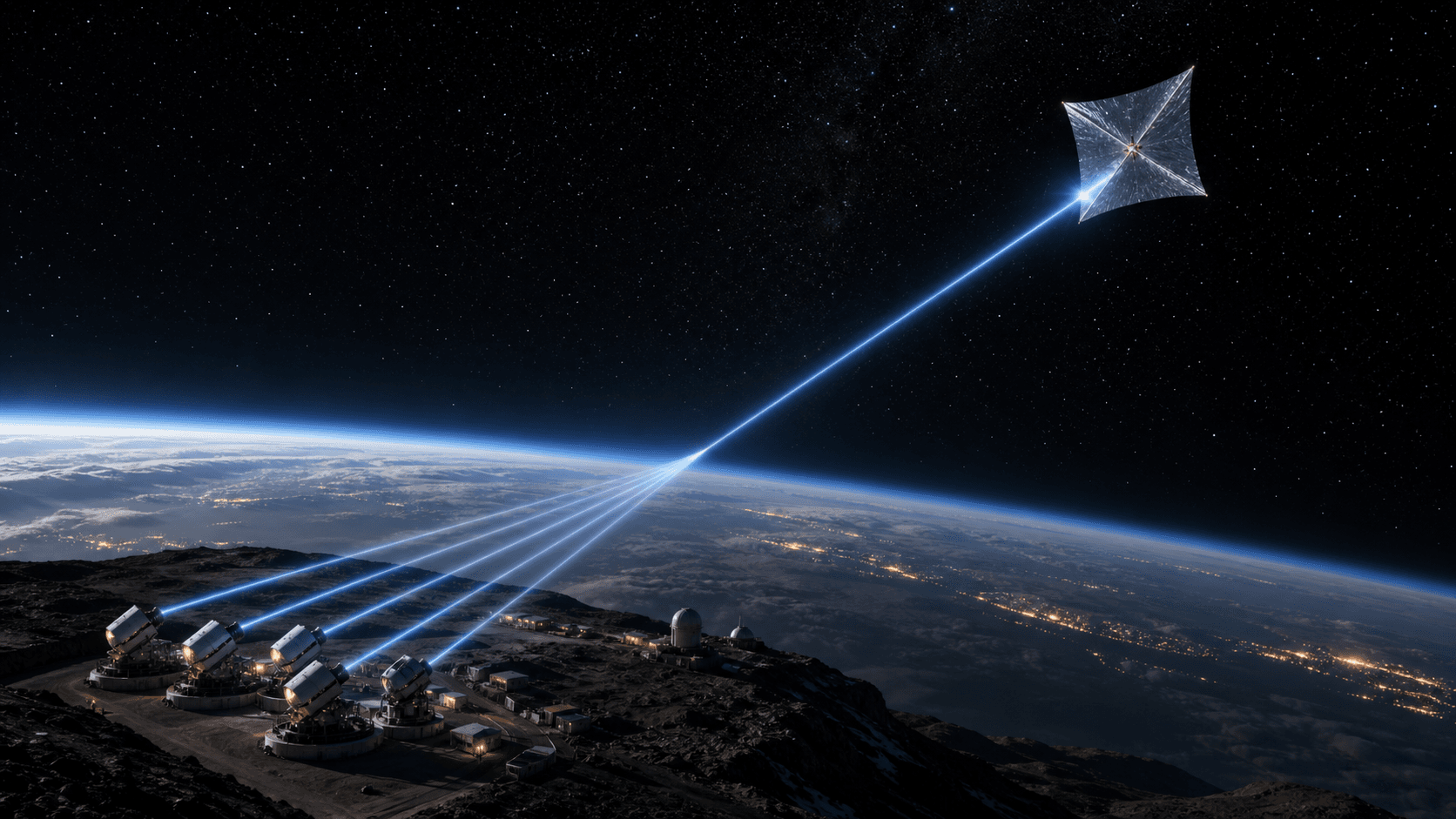
Air bends and blurs light. A ground array would need excellent weather, a high site, adaptive optics, and real-time correction to keep many laser elements focused together.
Aim
The target may be small, fast, and thousands of kilometers away. Tracking errors that look microscopic on the ground can make the beam miss completely in space.
Heat
A sail must reflect almost all incoming energy. Even a small amount of absorption can overheat, warp, or destroy an ultrathin material.
Power
Useful systems may require enormous electrical power, energy storage, cooling, and large numbers of precisely synchronized laser emitters.
Safety
Any high-power beam needs strict exclusion zones, aircraft and satellite coordination, automatic shutdown logic, cybersecurity, and international rules.
Braking
A beam near Earth is good at sending a probe away. Slowing down at a distant destination is harder and may require a second beam, a solar sail maneuver, magnetic braking, or a high-speed flyby instead of orbit entry.