If a large asteroid were confirmed to be heading toward Earth, the safest outcome would usually come from changing its arrival time by a few minutes, years before impact. Nuclear energy could provide an unusually powerful push when the object is too large or the warning time is too short for a conventional spacecraft.
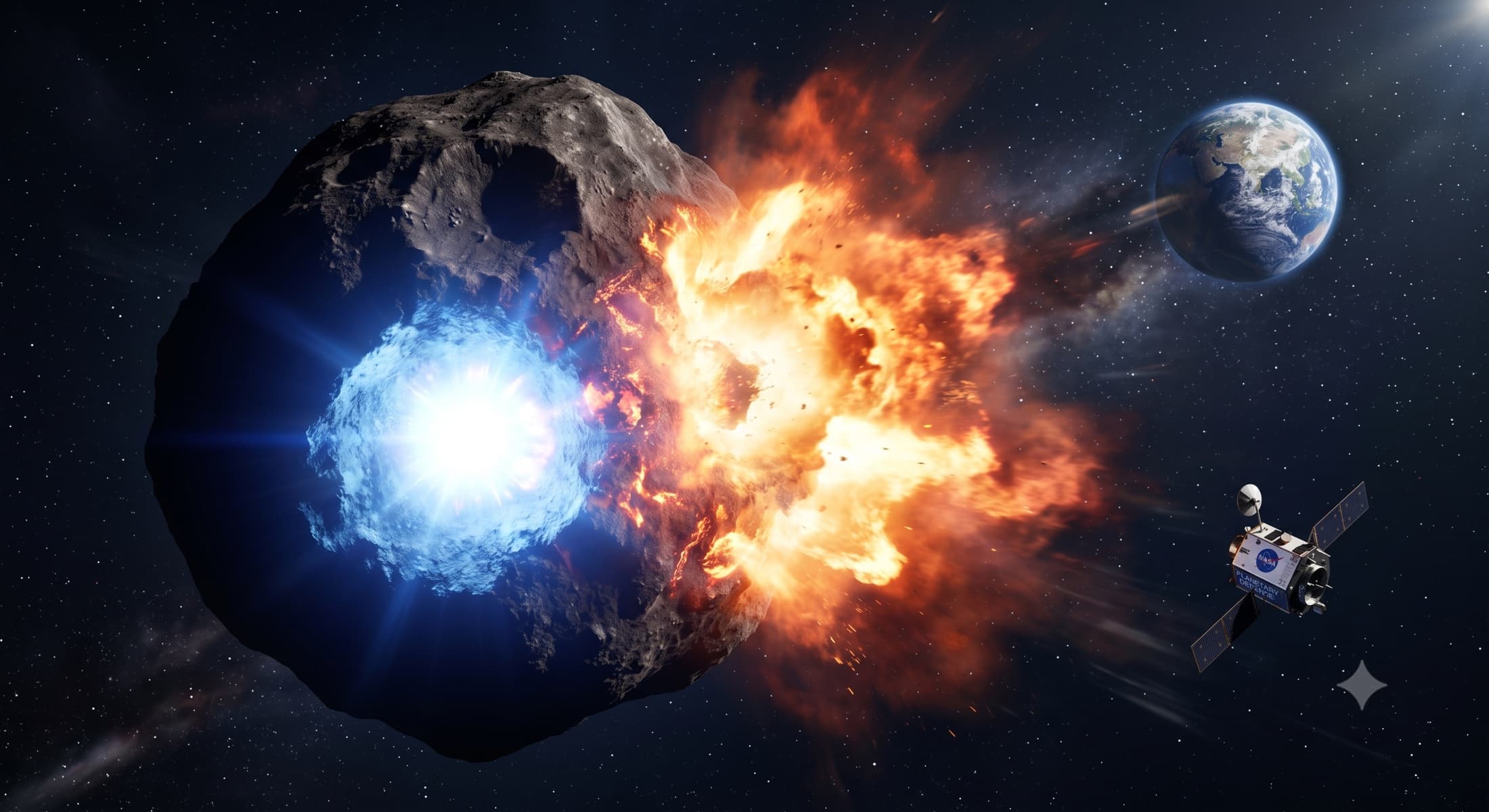
AI-generated concept illustration • Not an operational NASA mission
Proven in spaceKinetic impact changed Dimorphos' orbit
Modeled, not testedNuclear deflection and disruption
Best defenseFind the threat as early as possible
The Central Idea
Earth does not need the asteroid gone. It needs the asteroid somewhere else.
Earth moves roughly one planetary diameter along its orbit in about seven minutes. If an intervention makes a threatening asteroid reach the crossing point early or late, the two bodies never meet. With enough lead time, a velocity change too small to notice at first can accumulate into a miss measured in thousands of kilometers.
That is why planetary defense begins with detection, tracking, and characterization. The earlier a real threat is found, the gentler, simpler, and more testable the response can be.
A Ladder of Responses
Use the least disruptive method that can reliably prevent impact.
No single technique works for every asteroid. The choice depends on what is coming and how much time remains.
01Demonstrated
Kinetic impactor
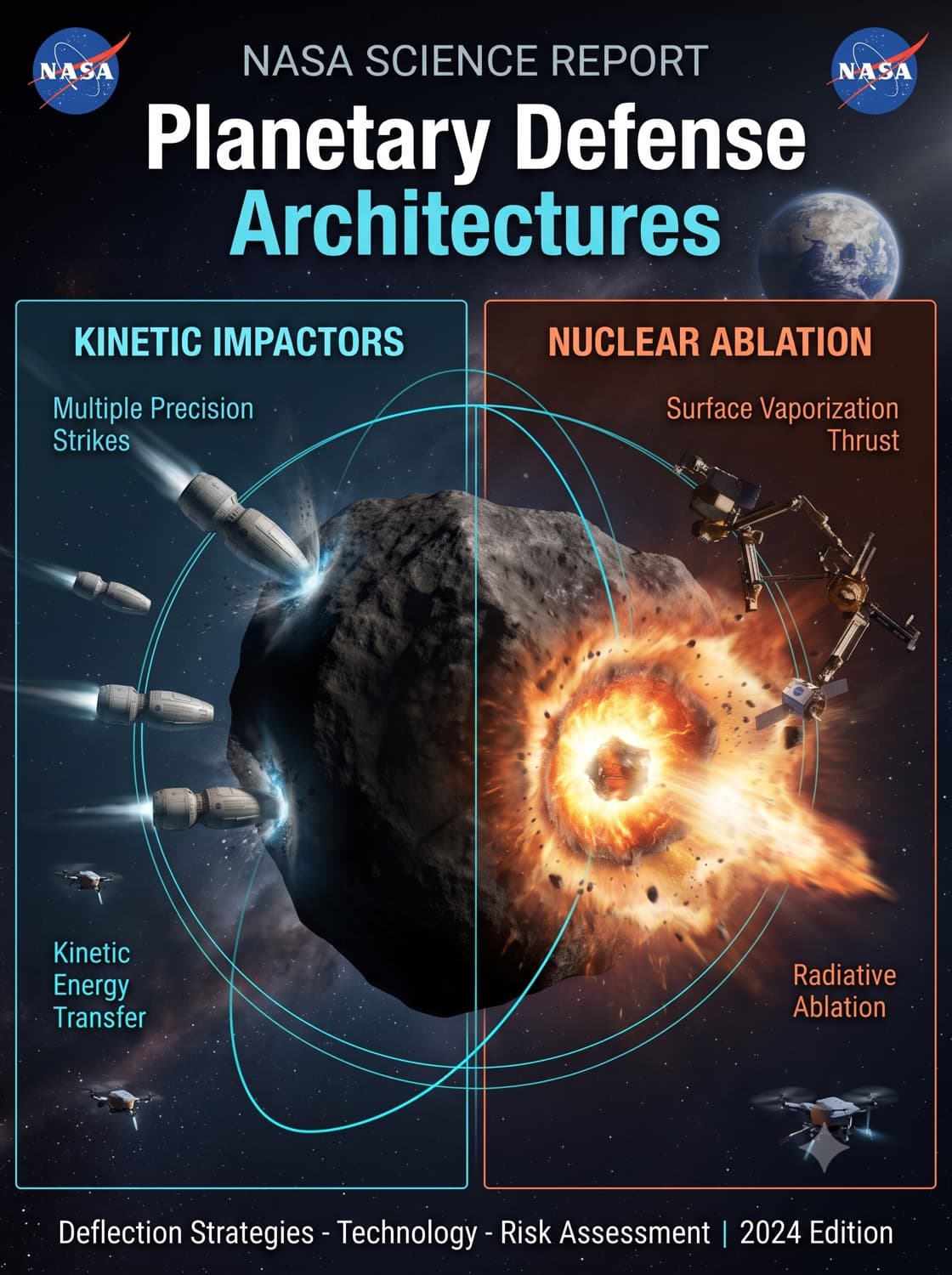
Crash an uncrewed spacecraft into the asteroid. The spacecraft transfers momentum, while rock thrown from the impact can add an extra push. NASA's DART mission proved this can change an asteroid's motion.
Best fit
Long warning time and a target that can be moved with one or more impactors.
02Concept
Gravity tractor
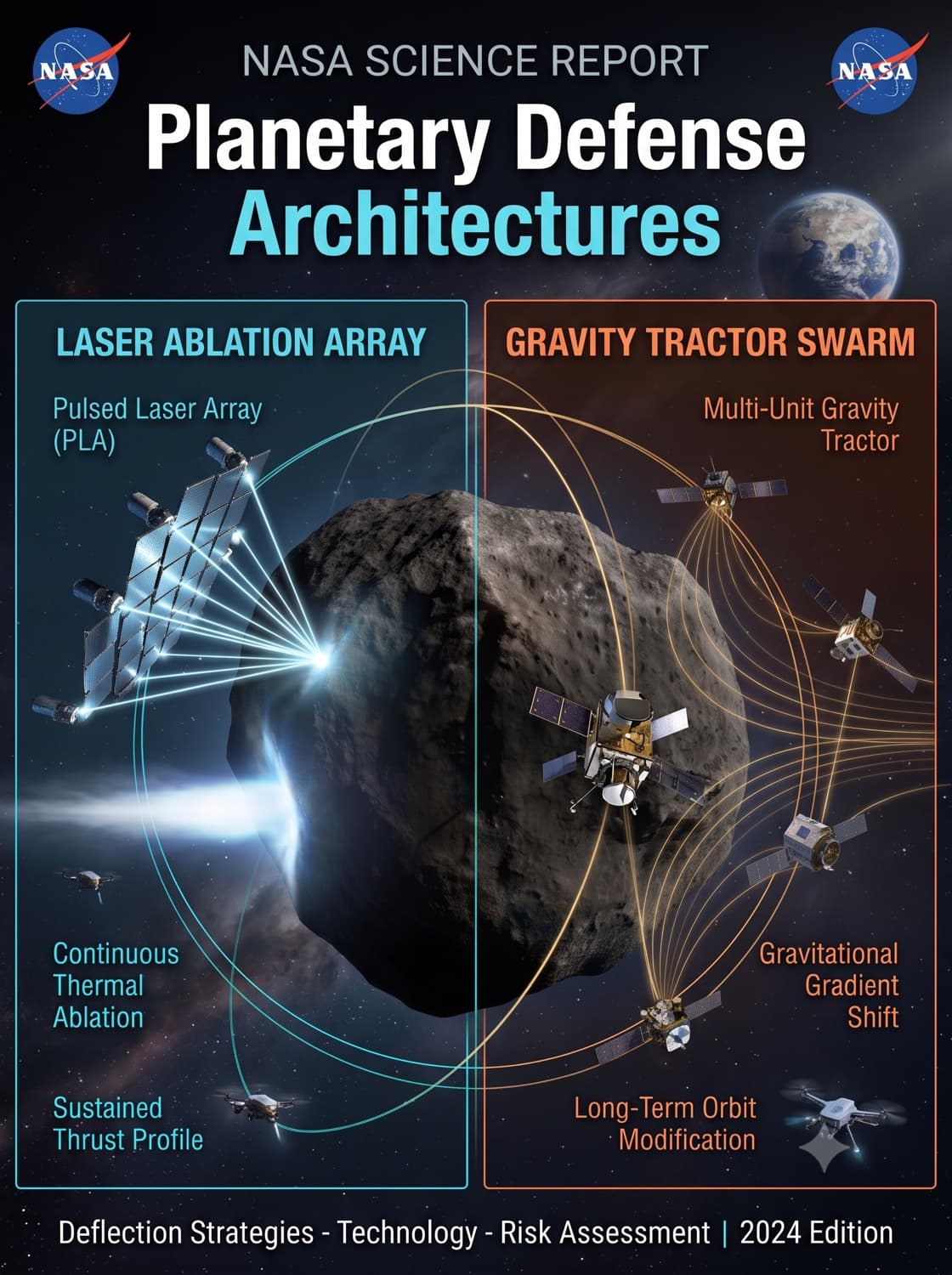
Hover a spacecraft near the asteroid and let the tiny gravitational attraction between them slowly pull the object onto a safer path. It is precise, but the force is extremely small.
Best fit
A well-understood object found many years or decades before impact.
03Concept
Surface ablation
Heat a patch of the surface with concentrated light or other directed energy. Escaping vapor acts like a small rocket plume and gradually changes the asteroid's velocity.
Best fit
Long-duration missions where a sustained, controlled push is possible.
04Simulated
Nuclear stand-off
Detonate a nuclear explosive near, not inside, the asteroid. Radiation rapidly heats and vaporizes a thin surface layer. The escaping material pushes the remaining body in the opposite direction.
Best fit
A large object, limited warning time, or a case beyond the practical reach of kinetic impactors.
33:15
The Demonstrated Baseline
DART proved that humanity can deliberately change an asteroid's motion.
NASA's DART spacecraft struck the 170-meter moonlet Dimorphos in 2022. Later analysis found its orbit around Didymos became 33 minutes and 15 seconds shorter. DART was a controlled test on an object that posed no danger to Earth. It validated kinetic impact, not nuclear deflection.
How the Nuclear Push Works
In vacuum, the useful force is not a Hollywood blast wave.
01
Detonate nearby
A stand-off device releases energy at a carefully chosen distance from the asteroid rather than burrowing into it.
02
Heat the surface
Radiation deposits energy in a thin layer of material on the illuminated side.
03
Create ejecta
The heated material vaporizes and rushes away from the asteroid at high speed.
04
Change the path
The escaping material produces an equal and opposite impulse, nudging the remaining asteroid onto a new trajectory.
The difficult part is prediction: composition, porosity, shape, spin, and internal structure all change how the energy couples into the target.
Three Nuclear Outcomes
Deflection preserves one body. Disruption creates many.
01
Most controllable nuclear concept
Stand-off deflection
A device would detonate at a distance from the surface. In vacuum there is no atmospheric blast wave. Instead, radiation heats a shallow layer of the asteroid so quickly that material blows away. That ejecta supplies the reaction force that changes the asteroid's velocity.
02
Stronger coupling, more uncertainty
Surface or near-surface burst
Moving the energy source closer can transfer more energy into the body, but also drives stronger shock waves and raises the chance of uncontrolled fragmentation. Target composition and geometry become critical.
03
Emergency last resort
Disruption
If warning time is too short to create a clean miss, models examine breaking the object apart and dispersing the pieces. Success would require fragments to miss Earth or become small enough to reduce the damage. A partial disruption could make the hazard worse.
Why “Destroy It” Is Dangerous
Turning one known threat into a cloud of uncertain threats is not automatically a win.
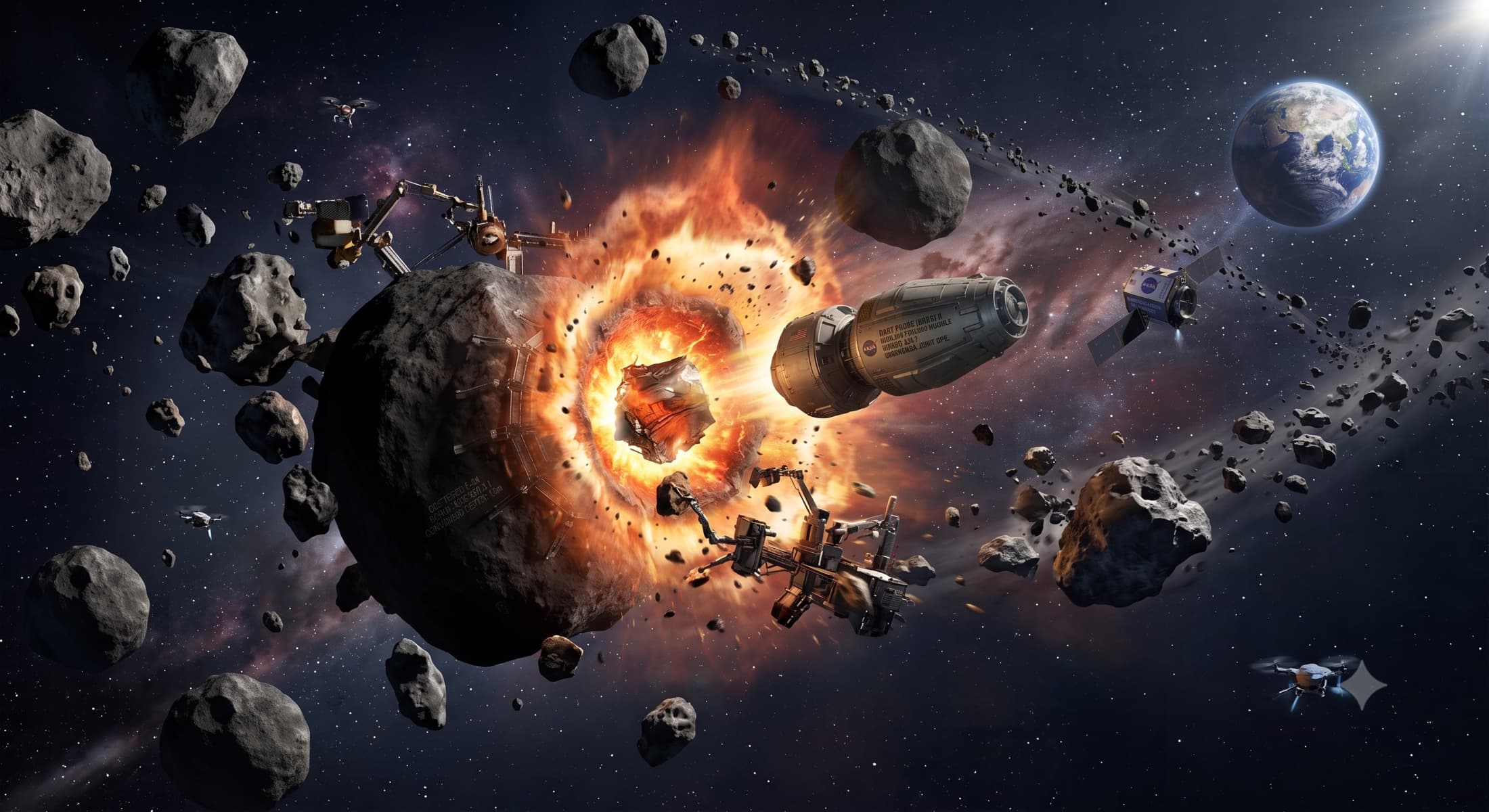
A disruption mission would have to disperse fragments far enough, early enough, and in directions that keep them from striking Earth. Large pieces could retain nearly the original trajectory. Smaller pieces may still reach the atmosphere. Every fragment adds a new tracking and consequence problem.
AI-generated concept illustration • Fragmentation shown for explanation, not prediction
What Determines the Plan?
The asteroid decides the engineering problem.
Mission planners would evaluate ranges of outcomes because many target properties remain uncertain until close observation.
Warning time
Years of lead time let a tiny nudge grow into a large miss distance. Short warning time demands a much stronger and riskier intervention.
Size and mass
A larger body has more momentum and may require far more delivered energy to alter its path.
Structure
A solid rock, metal-rich body, porous object, and loose rubble pile can respond very differently to the same intervention.
Spin and shape
Rotation changes where energy lands and how ejecta leaves the surface. Irregular shape complicates navigation and modeling.
Orbit certainty
Mission planners must know the future impact path precisely enough to avoid merely moving the impact point somewhere else on Earth.
Launch opportunity
The response has to be built, launched, navigated, and delivered before the remaining intervention window closes.
Strategy Board
Planetary defense is a portfolio, not a single superweapon.
These supplied illustrations visualize the broad families of responses discussed on this page.
AI-generated concept infographic • Not a NASA publication or an official mission designAI-generated concept infographic • Not a NASA publication or an official mission design
What a Real Response Requires
The mission begins long before any spacecraft launches.
01
Find
Survey telescopes discover the object and collect enough observations to calculate its orbit.
02
Confirm
Independent teams refine the impact probability and determine whether Earth is truly at risk.
03
Characterize
Radar, spectroscopy, thermal measurements, and ideally reconnaissance constrain the object's size, mass, spin, composition, and structure.
04
Model
Teams compare outcomes across uncertain target properties and multiple response methods.
05
Choose
National and international leaders select a response only after technical, legal, and humanitarian review.
06
Deliver
One or more spacecraft intercept the target, then observers verify the actual trajectory change.
07
Follow up
If the first intervention is insufficient, a prepared second mission adds more deflection while time remains.
A Planetary Decision
No nation should make this choice in isolation.
Launching a nuclear explosive into space would cross technical, diplomatic, legal, security, and environmental boundaries. Existing treaties restrict nuclear weapons in outer space and nuclear explosions in space. A real emergency would demand transparent international coordination, shared tracking data, clear civilian control, and a lawful authorization process.
The destination of a partially successful deflection matters too. Preventing one impact must not shift risk from one population to another. Planetary defense is literally a problem of public trust at planetary scale.
Research Further
Primary and professional sources
This page explains public research at a high level and does not provide weapon design or deployment instructions.