unrecovered per 100 L processed

Every Drop Counts
LIFE SUPPORT FILE / 001The water that
The water that
keeps coming back.
On a spacecraft, water is not something you simply use up. It is something you fight to keep.
Explore the 98% milestone ↓DEMONSTRATED WATER RECOVERY98%
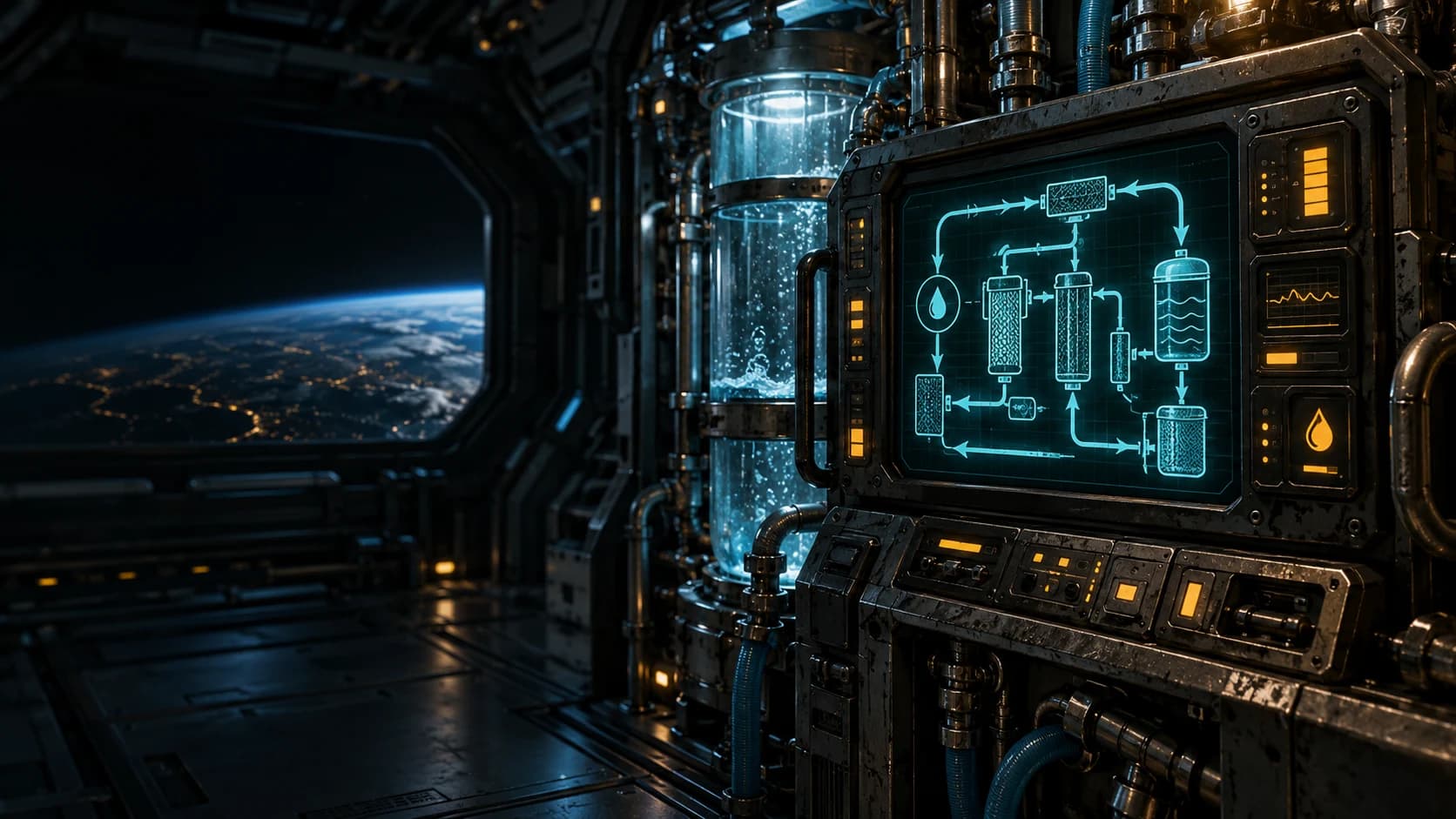
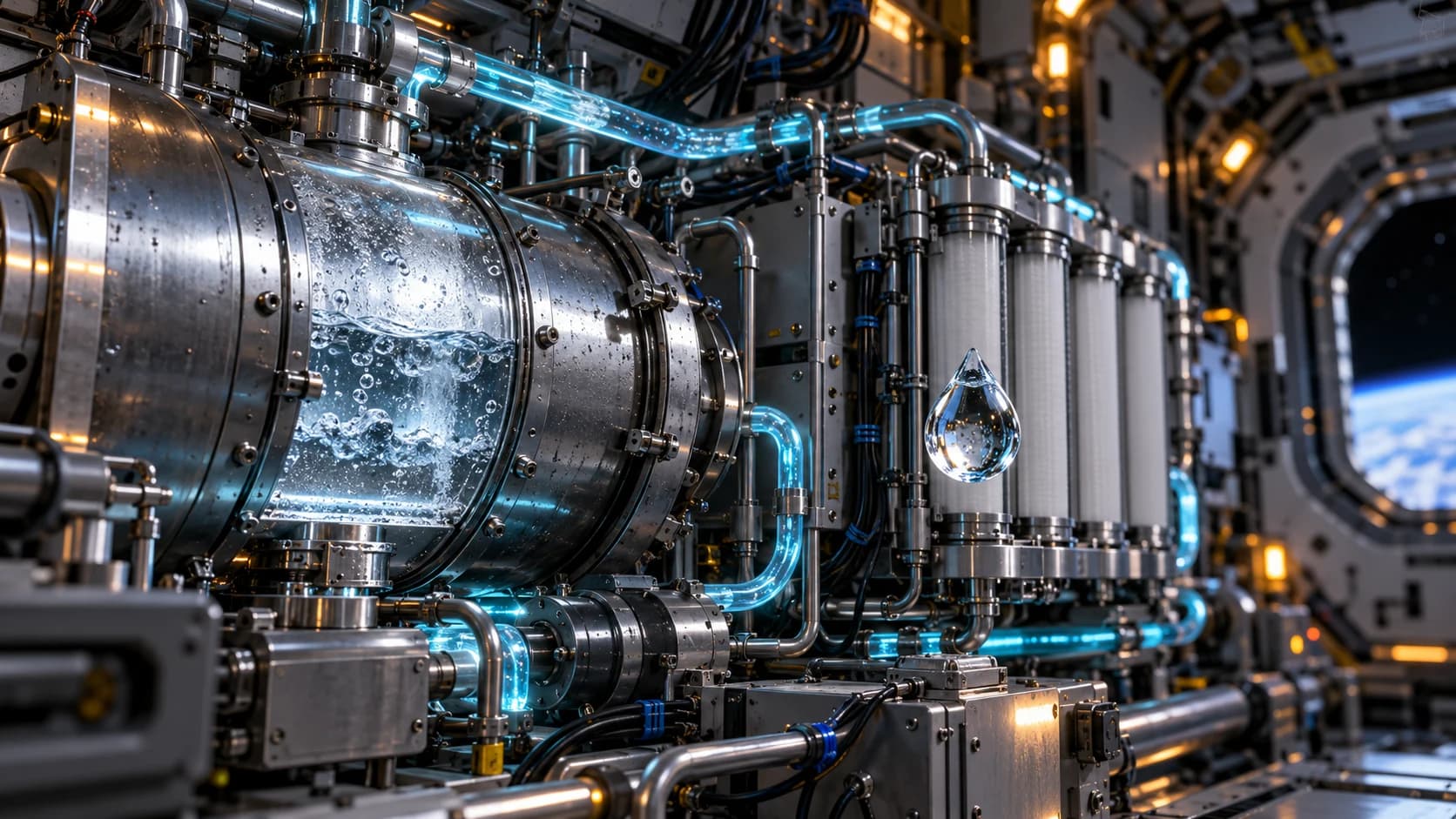
AI-generated concept art • Fiction-inspired interface, not actual ISS hardwareNASA milestone reported June 2023
Not live telemetry • Not 100% closure
Almost a closed loop.
An enormous step forward.
In June 2023, NASA reported that its space-station life-support system demonstrated 98% total water recovery with help from the Brine Processor Assembly. Previously, recovery was about 93–94%. NASA’s year-end summary describes the achievement as recycling water collected from the U.S. segment—not every water stream across the entire station.
This is a recovery rate, not a water-purity score, an energy-efficiency rating, or a promise of uninterrupted performance. Some water is still lost; replenishment, maintenance, and spare parts still matter.
Sources: NASA’s milestone report · NASA’s 2023 ISS achievements
“Nearly 100%” does not mean infinite water. It means far less water has to be replaced.
From waste stream
to drinking water.
Water from urine, cabin humidity, and other recoverable sources enters a treatment system. The water processor combines filtration with catalytic purification; the urine processor uses distillation before its recovered water receives further treatment. NASA’s ECLSS reference explains the hardware.
- COLLECT
Capture moisture
Humidity collection recovers water released through breathing and perspiration.
- DISTILL
Separate the urine stream
Vacuum distillation recovers water, leaving a concentrated brine.
- RECOVER
Work on the leftovers
The brine processor uses membranes and warm, dry air to release additional water vapor for collection.
- PURIFY
Treat and verify
Filters and a catalytic reactor treat collected water. Sensors check quality; unacceptable water is reprocessed. Iodine helps prevent microbial growth in accepted stored water.
Process sources: NASA’s brine-processor explanation · ECLSS fact sheet (PDF). Simplified flow: actual plumbing has separate branches, storage, and control systems.
The real story is
what you stop losing.
Consider a simplified 100-liter batch of recoverable water. At 94% recovery, 6 liters do not return. At 98%, that drops to 2 liters.
unrecovered per 100 L processed
less unrecovered water at the same throughput
That is only a four-percentage-point improvement in recovery—but roughly a 67% reduction in losses. Repeated over a long mission, the difference adds up.
Illustrative mission arithmetic—not an ISS operating estimate.
If a hypothetical system processes 100 liters daily for 1,000 days, steady losses would total 6,000 liters at 94% or 2,000 liters at 98%. The 4,000-liter difference is about four metric tons of water. This assumes fixed throughput and recovery; it excludes other water sources, losses, reserves, and equipment mass.
A spacecraft needs
a water cycle of its own.
Less dependence on deliveries
Every liter recovered is one that does not immediately need replacing. That changes how mission planners think about logistics, storage, and reserves.
More room for the mission
Reducing consumable requirements can free mass for instruments and other supplies. The net benefit must still account for the processor, power, filters, and spares.
A foundation for long journeys
NASA identifies regenerative life support as critical beyond low Earth orbit. Water recovery is one part of that challenge—not proof that a self-sufficient Mars habitat is already solved.
Mission context: NASA’s water-recovery milestone · NASA technical report: reliability and resupply improvements.
And back on our own planet?
Spaceflight makes the value of reuse impossible to ignore. NASA-linked filtration work has also contributed to water-treatment products for remote locations. That does not make an ISS rack a universal solution: communities still need systems suited to local contaminants, power, maintenance, affordability, and access.
98% is not invincibility.
High recovery does not eliminate leaks, contamination risks, equipment failures, or the need for backup supplies. A complete life-support system must also handle air, waste, pressure, and temperature. The breakthrough is not that humans can stop caring about water—it is that engineering lets them keep using it.
The industrial life-support screens of Battlestar Galactica inspired this page’s visual mood. The science comes from NASA; the original artwork and display styling are illustrative, not fictional technology presented as fact.
The research behind the story.
- NASA: Water Recovery Milestone (June 20, 2023)
- NASA: 2023 Space Station Achievements
- NASA: Environmental Control and Life Support Systems
- NASA: ECLSS fact sheet (PDF)
- NASA Technical Reports Server: Water Recovery System upgrades
- NASA Spinoff: Clean Water for Remote Locations
This independent educational article describes a demonstrated milestone, not live station status. Calculations are explicitly illustrative; images are AI-generated concepts.
Explore what astronauts drink →