Salyut 7 loses power and ground contact, beginning an uncontrolled drift.

The FOIA Files

CASE FILE 001 • NASA • CLOSED
AI-generated visualization of an unverified theory • Not a historical photographDid NASA consider using a Space Shuttle to retrieve Salyut 7?
A request built around a Cold War spaceflight theory, NASA's unusually fast no-records determination, and the difference between an archival result and an engineering verdict.
The response neither confirms the theory nor fully tests it.
NASA found no responsive records in the two repositories and keyword combinations named in its letter. That is meaningful negative evidence. It is not proof that no one in NASA, the military, or the intelligence community ever discussed the idea. Separately, the actual Shuttle missions' orbital planes, propulsion limits, payloads, and timing make a literal capture extraordinarily implausible.
THE 1985 WINDOW
The dates overlap. The orbits do not.
STS-51B flies Spacelab 3 in a 57°-inclination orbit.
Soyuz T-13 launches, docks manually, and begins restoring Salyut 7.
STS-51G flies communications satellites and Spartan 1 at 28.45° inclination.
THE REQUEST
A good first request—with room for a second pass.
- Named STS-51B and STS-51G and supplied a January–July 1985 window.
- Asked for identifiable record types: reports, internal communications, debriefs, and planning documents.
- Specified orbital tracking, retrieval, proximity operations, Salyut 7, and NASA–DoD communications.
- Addressed fees, partial denials, exemptions, and appeal rights.
- “All records” was broad, but no offices, programs, record systems, or individual custodians were named.
- The terminology did not include likely variants such as DOS-6, Salut 7, intercept, rendezvous, recovery, salvage, or inspection.
- The theory could implicate records outside NASA, especially defense, intelligence, diplomatic, or National Archives holdings.
- The request paired each mission term with topic terms, which may miss records that discussed the station without naming a flight.
NASA'S FORMAL ANSWER
A defined search, not a government-wide conclusion.
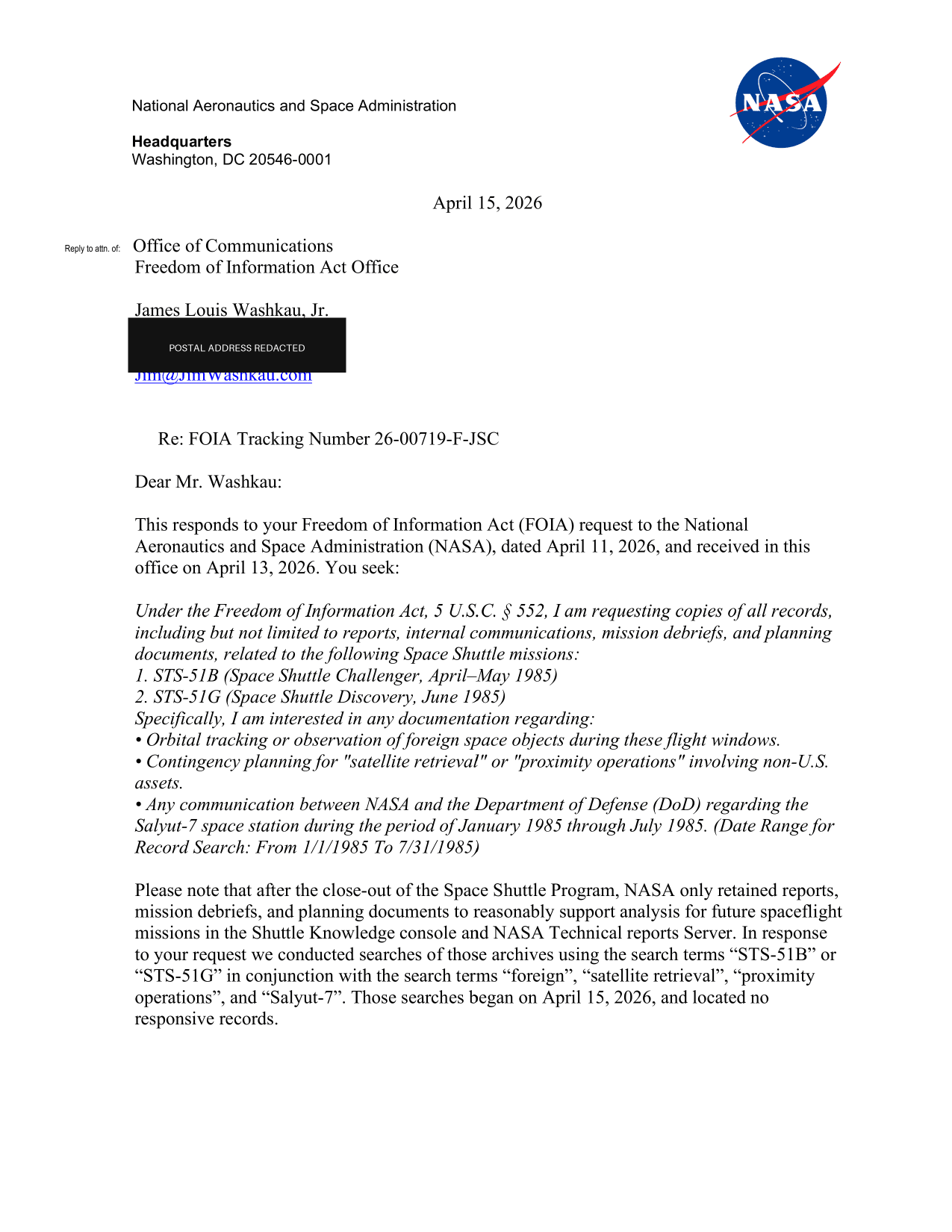
The determination says NASA searched the Shuttle Knowledge Console and NASA Technical Reports Server. It combined “STS-51B” or “STS-51G” with “foreign,” “satellite retrieval,” “proximity operations,” and “Salyut-7.” No responsive records were located.
The request was received April 13; the searches began April 15; and the letter is dated April 15. That two-day path is consistent with a focused archive search. The letter does not describe searches of Headquarters executive files, JSC program-office records, Mission Operations holdings, named custodians, DoD liaison files, or records held by another agency.
Important distinctionNo FOIA exemption was used here. NASA said it found nothing responsive in the search it described; it did not say records were found and withheld.
THE ORBITAL-MECHANICS CHECK
The literal capture scenario runs into a wall of delta-v.
This calculation is an inference from NASA's published mission inclinations and Shuttle propulsion data—not a statement contained in the FOIA response.
orbital inclination
5.4° plane mismatch
23.15° plane mismatch
STS-51B PLANE CHANGE≈ 725 m/s2v sin(Δi/2), using ≈7.7 km/s orbital speed
VS.SHUTTLE OMS CAPABILITY≈ 305 m/spublished total delta velocity with a 65,000-lb payload
The estimated plane change alone exceeds the cited OMS budget by more than two times—before rendezvous, capture, departure, and landing requirements. STS-51B also carried Spacelab 3 in its payload bay. STS-51G's plane mismatch was far larger. Observation or contingency discussion is a different, less demanding claim, but this response supplies no evidence for it.
WHAT I THINK
A fascinating lead, but not a substantiated operation.
NASA performed the specific repository and keyword searches described in its letter and reported no responsive records.
The response does not establish that every relevant NASA office—or any DoD, intelligence, diplomatic, or archival system—was searched.
Using either named mission to physically capture Salyut 7 is inconsistent with the available plane-change budget and mission configuration.
The documentary theory should remain labeled unverified. The strongest next step is a series of smaller, custodian-specific requests.
NEXT SEARCH PATH
Turn one broad theory into several narrow searches.
- 01NASA Headquarters + JSC Name the Shuttle Program, Flight Design and Dynamics, Mission Operations, and DoD-liaison custodians.
- 02Expand the vocabulary Search Salyut 7, Salyut-7, Salut 7, DOS-6, intercept, rendezvous, retrieval, recovery, salvage, inspection, and foreign orbital object.
- 03Separate the agencies Request potentially responsive records directly from defense, intelligence, diplomatic, and archival custodians rather than expecting NASA to hold them.
The case analysis uses the supplied request email, NASA's April 15 determination, and NASA's follow-up email. Orbital data and mission context come from NASA's 1985 chronology, STS-51G mission record, Salyut history, Soviet mission chronology, and Shuttle OMS technical data. Calculations are approximate and clearly identified as analysis.